

A church AV company designs and installs the audio, video, and lighting systems a house of worship uses for services, livestream, and events. There are four common ways to buy one: a church AV specialist, a general/corporate AV integrator, a big-box or pro-audio retailer, or DIY with volunteers. The right choice depends on your room, your budget, and — most of all — who will run the system on Sunday.
Below you'll find a quick recommendation, the four ways churches buy AV, a side-by-side comparison, and the questions to ask before you sign anything.
Best choice by situation
- Church AV specialist — if volunteers will run the system after the installer leaves.
- General / corporate integrator — if your church employs full-time technical staff.
- Big-box / retailer — for a known, like-for-like replacement.
- DIY with volunteers — only for small rooms or a highly capable, documentation-minded volunteer team.
The four ways churches buy AV
1. A church AV specialist
An integrator that works only with houses of worship. They understand worship workflows, volunteer operators, and phased ministry budgets by default, and they design systems around presets and scene recall so a volunteer can run a service without an engineer on call. Designing around volunteer operators is a widely recognized best practice in church tech (see Church Production Magazine). Tech in Church is one example — every install ships with mandatory training and client-safe as-built documentation.
2. A general or corporate AV integrator
A firm that installs AV for offices, schools, stadiums, and venues. The engineering is often excellent, but the default assumptions are corporate: a paid, full-time operator and a maintenance contract. Dropped into a church, that can mean a console your volunteer team is afraid to touch — and corporate hourly rates.
3. A big-box or pro-audio retailer
A retailer (or its install arm) that sells boxes and bolts them in. Good for replacing a known item — a dead amp, a few mics — at a fair price. Weaker on system design: no one is responsible for how the whole signal chain works together, and there is rarely documentation or Sunday-morning support.
4. DIY with volunteers
A capable volunteer assembles gear over time from Sweetwater or B&H. Lowest sticker price, full control. The risk is that no one captures the design intent — when that volunteer leaves, the next person inherits an undocumented system, and emergency fixes add up to more than a designed install would have cost.
Church AV options compared
| Church AV Specialist | General / Corporate Integrator | Big-Box / Retailer | DIY (Volunteers) | |
|---|---|---|---|---|
| Understands worship workflows | By default — it's all they do | Sometimes; church is one vertical | Rarely | Your team already knows it |
| Designed for volunteer operators | Yes — presets & scene recall as a rule | Often assumes a paid operator | No design step | Depends on the volunteer |
| Integrates gear you already own | Yes — keeps working gear in | Varies; may prefer rip-and-replace | Usually sells new | Yes |
| Training included | Mandatory on every install | Available, often billed | Rarely | Self-taught |
| As-built documentation | Yes — signal flow, config, warranty | Usually, corporate-style | No | No |
| Ongoing support / care plans | Annual remote + on-site tune-ups | Service contract | Per-incident | None |
| Scheduling around services | After-hours standard, no premium | Business hours; after-hours upcharge | Business hours | Anytime |
| Pricing approach | Itemized, phased, scoped to the room | Corporate rates | Retail / per item | Hardware cost only |
| Best fit for | Churches that want a system their team can run and keep | Churches with full-time AV staff | One-off replacements | Very small rooms / tight budgets |
Generalizations across categories — individual companies vary. Use it as a starting point, then ask the questions below.
Questions to ask any church AV company
- Do you work with churches specifically — or is worship one of many verticals?
- Will our volunteer team be able to run this without you on call?
- Do you provide as-built documentation and hands-on training before handoff?
- Will you integrate the gear we already own, or replace everything?
- Is pricing itemized? Will you make changes without our written sign-off?
- Can the project be phased so we spread the budget across giving cycles?
- What does support look like the week after — and the year after — install?
Church-Only by Design
How Tech in Church Fits
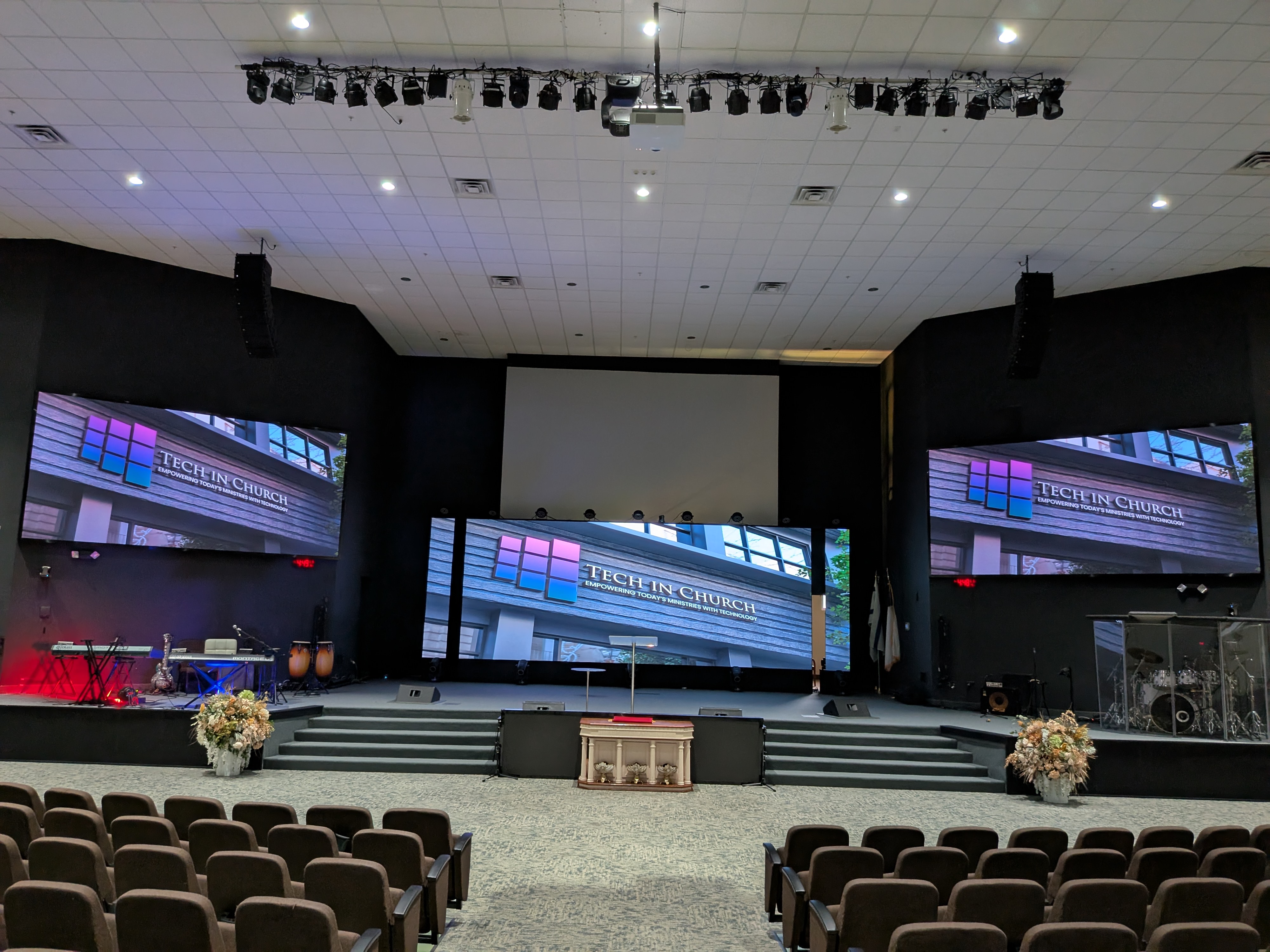
Tech in Church is a church-only AVL integrator based in Columbus, Ohio, with regular out-of-state work. Volunteer-first design is a hard rule, not a marketing line: if a system can't be run with one-button scene recall, we don't ship it. We're known for removing line items during scoping, we keep working gear in place, and every install ships with as-built documentation and mandatory training.
Every project hands off what a volunteer team actually needs: signal-flow diagrams, saved console scenes, printed training runbooks, and warranty sheets. Recent installs include a full sanctuary audio overhaul and LED wall at CPCG, a three-phase LED and lighting transformation at JPower, and a 12.9-ft LED video wall at Trinity Revival Ministries. We hold a 5.0★ rating across Google reviews and have installed 500+ LED panels for Ohio ministries.
See our full service list or explore LED video walls — including our LED wall cost guide — and audio systems in detail.
Frequently Asked
Choosing a Church AV Company — Common Questions
What's the difference between a church AV specialist and a general AV integrator?
A church AV specialist works only with houses of worship, so they design around worship workflows, volunteer operators, and phased ministry budgets by default. A general or corporate integrator builds excellent boardroom and venue systems, but often specifies gear that assumes a full-time, paid operator — which a volunteer team has to fight every Sunday.
Is it cheaper to install a church sound system yourself?
Up front, yes — buying gear piecemeal from a retailer is the lowest sticker price. But DIY usually costs more over time: no system design, no documentation, no tuning, and no warranty path when something fails mid-service. For very small rooms or tight budgets it can be a reasonable start; for a sanctuary the church will likely re-buy within a few years.
How much should a church budget for an AV system?
A focused audio refresh — mixer, wireless, in-ear monitors — typically runs $15K to $40K. A full sanctuary build-out across audio, video, and lighting runs roughly $40K to $120K and is often phased over one to two years so the budget spreads across giving cycles. A good integrator will scope to the room rather than sell a fixed package.
What should I ask a church AV company before hiring them?
Focus on fit, not features. What separates a real partner from a box-seller is who runs the system after handoff, whether you get documentation and training, whether they'll keep the gear you already own, and whether pricing is itemized with no surprise change orders. The full checklist is in the section above — use it on every company you talk to, including us.
Talk to a Church AV Specialist
A free consultation, honest scoping, and a quote that reads cleanly in a board meeting.
By submitting this form you acknowledge that you have read and agree to our Terms & Conditions. All proposals are subject to those terms.